Sample Grease Analysis Report

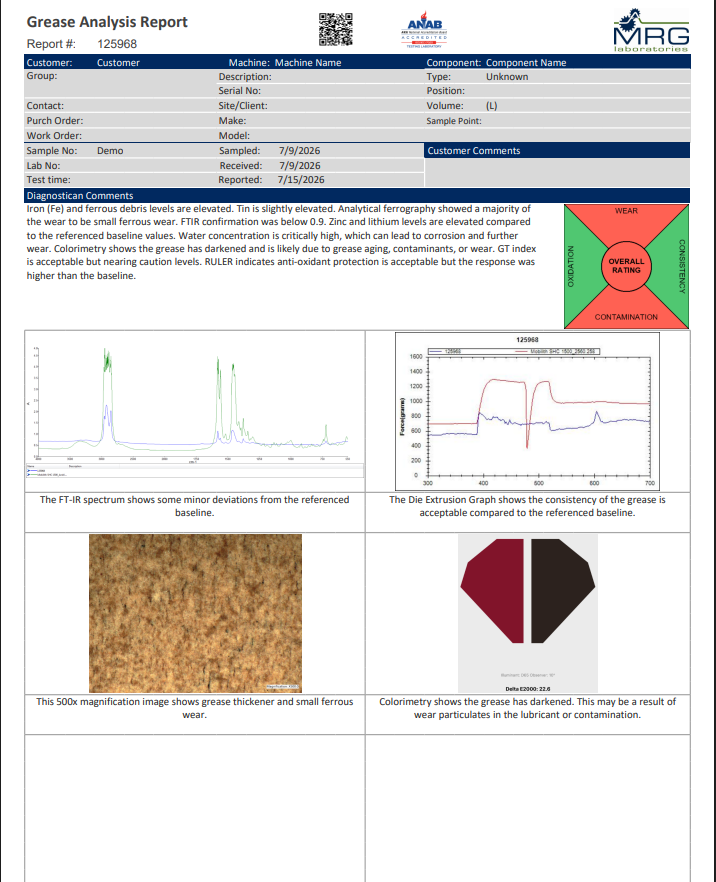
Grease Analysis Report Description

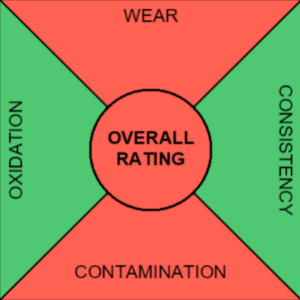
The Grease Rating provides a green, yellow, red color rating to evaluate each of the four areas examined during the analysis process.  Wear, consistency, contamination, and oxidation are evaluated individually to give an overall rating to the grease sample.  The overall rating receives the worst rating of the four individual tests.

THE GREASE RATINGS

Wear

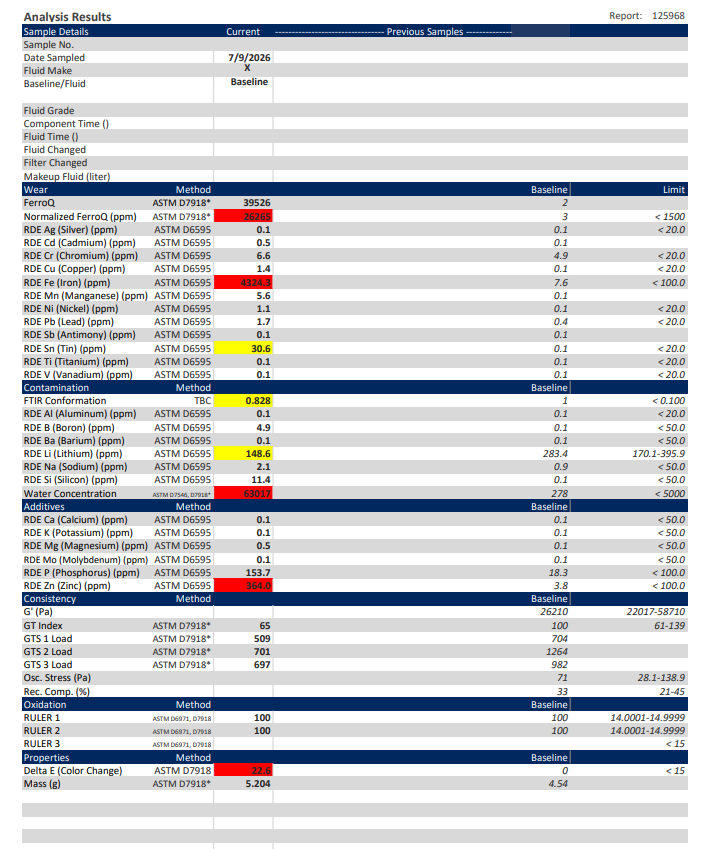
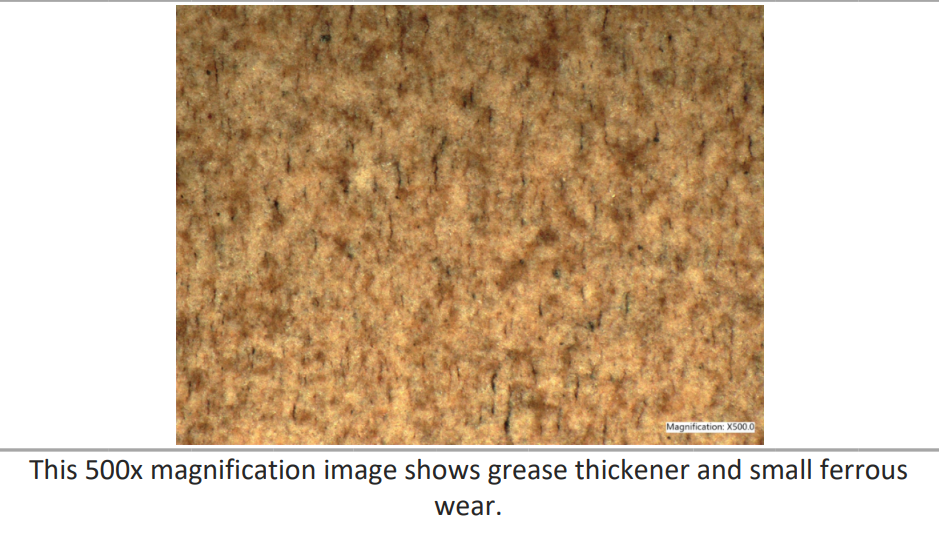
Wear testing detects the amount of ferrous debris and other wear metals in the grease.  Kittiwake’s ANALEX fdM+, RDE Spectroscopy, Direct Read Ferrography and analytical ferrography are used to evaluate wear. FdM+ values are elevated, as well as RDE Ferrous levels. They both have been increasing with each sample; therefore, a red rating is given to wear.

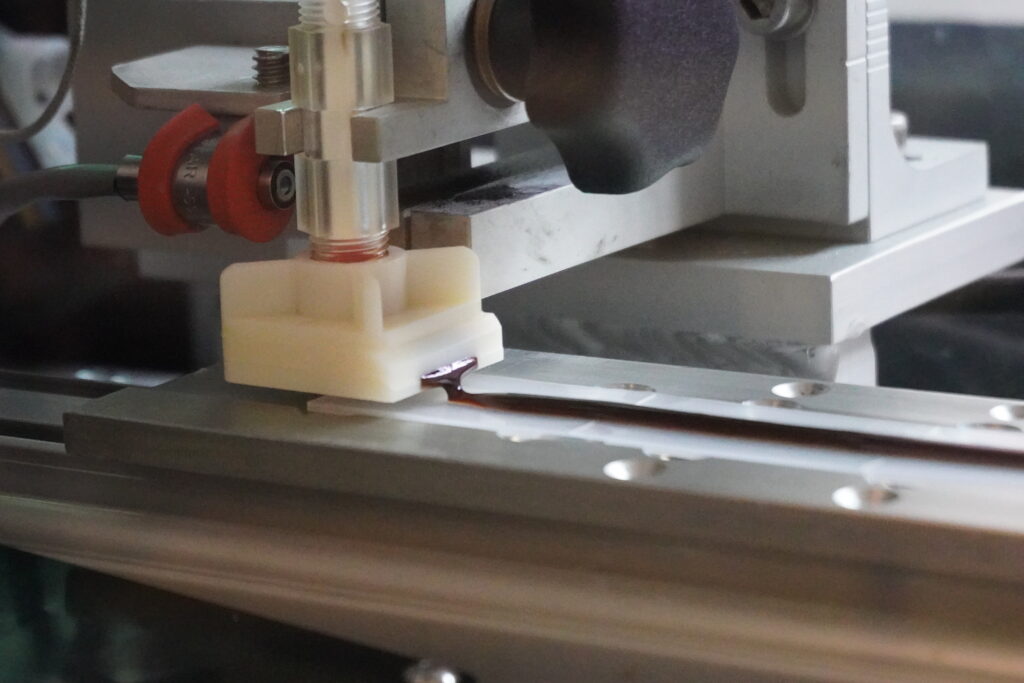
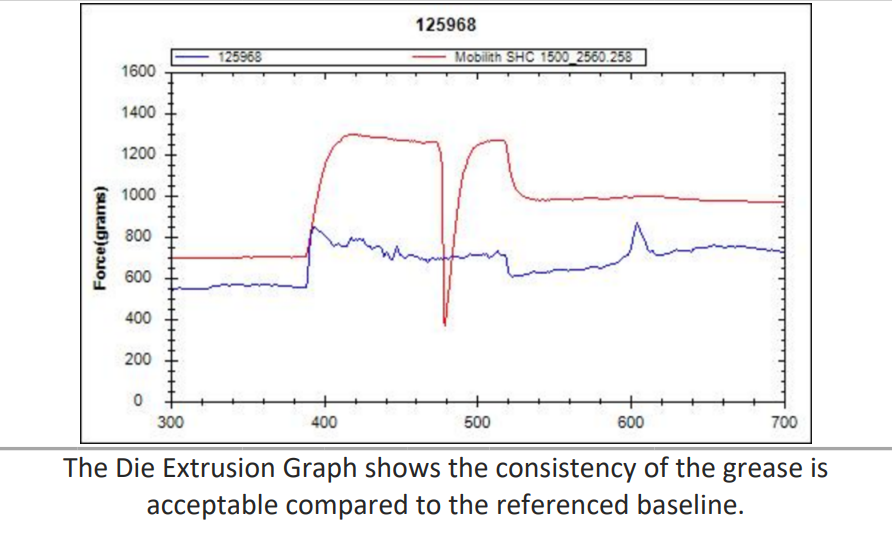
Using the Grease Thief, the grease is extruded through a specially designed extrusion die to evaluate changes in consistency as compared to the baseline grease.  This test shows whether the grease has hardened or softened.  This test also simultaneously prepares the sample on a thin plastic substrate for subsequent analysis.  Rheometer testing is also used in advanced analysis of consistency.  

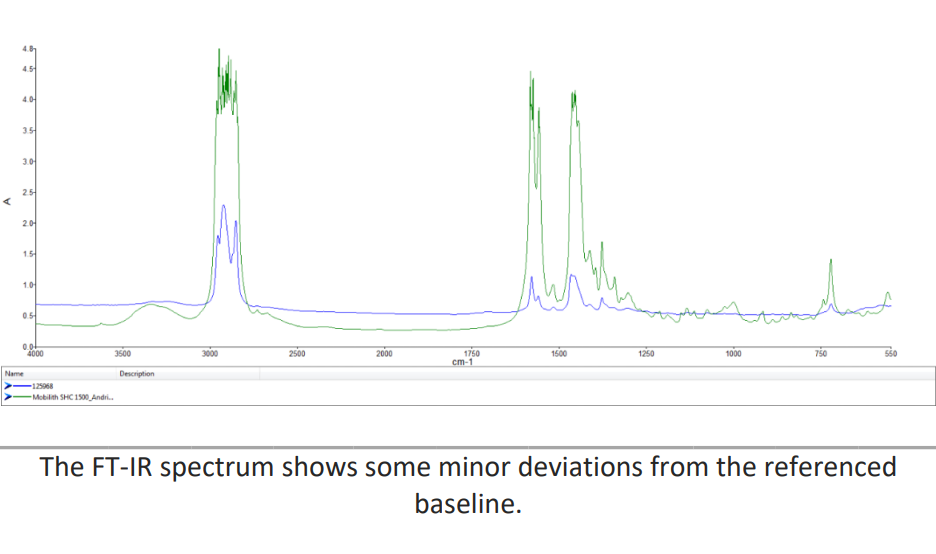
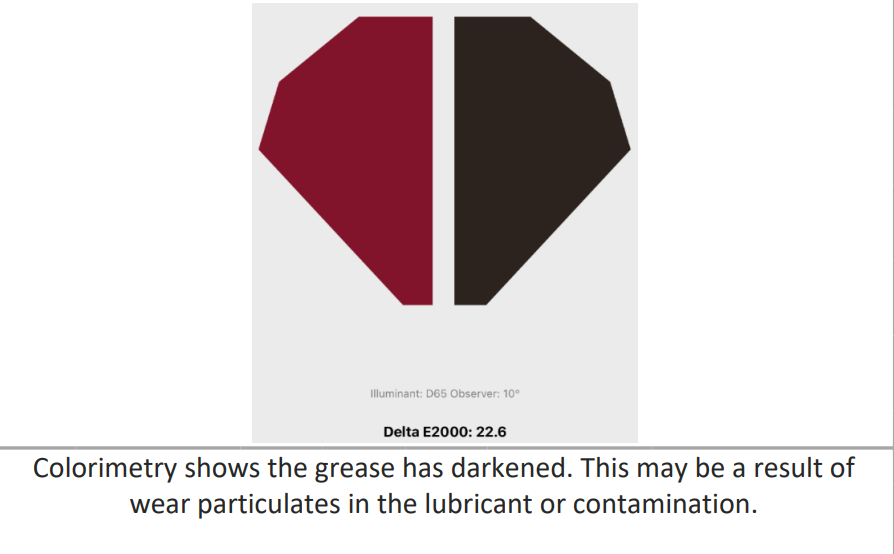
FTIR and other spectrometric techniques are utilized to determine mixing of different greases. Mixing of grease can be determined by looking at thickener type and additives.  Contamination is given a red rating.  The FTIR shows minor deviations from the baseline grease.

The onset of oxidation can be measured with several tests.  Measuring the residual amount of anti-oxidants exiting from the bearing, it can be determined if the re-greasing interval is sufficient for the equipment.  FT-IR can also be used to measure the progression of oxidation.  Oxidation receives a green rating.

EXPLANATION OF TESTS

Ferrous Debris Level

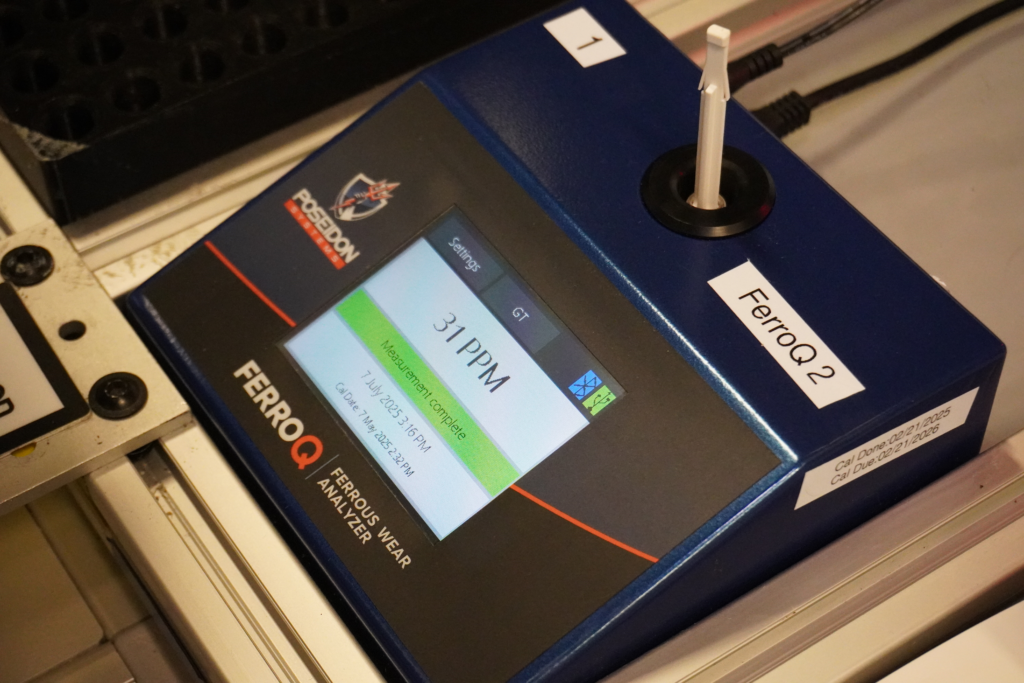
The Ferrous debris value is of most value to the analyst when it is trended over a period of time.  In this particular sample the value has increased with each sample along with RDE value in elemental spectroscopy. The FerroQ Analyzer is used as an overall monitoring device for wear concentration.  This test uses the Hall Effect to determine the amount of ferromagnetic material present in the sample.  This is used a general flagging device for the lab when wear levels are excessively high.  Generally, if the Iron content is elevated, then analytical ferrography will be applied.

Iron levels in the sample are steadily progressing upward. The spectrometer is useful is detecting certain wear particles, within certain size limitations, such as Iron and babbitt particulate.  Certain additive elements are also identified that could point towards grease mixing.  Comparing element levels to the original baseline, grease mixing and wear metals are easily detected.

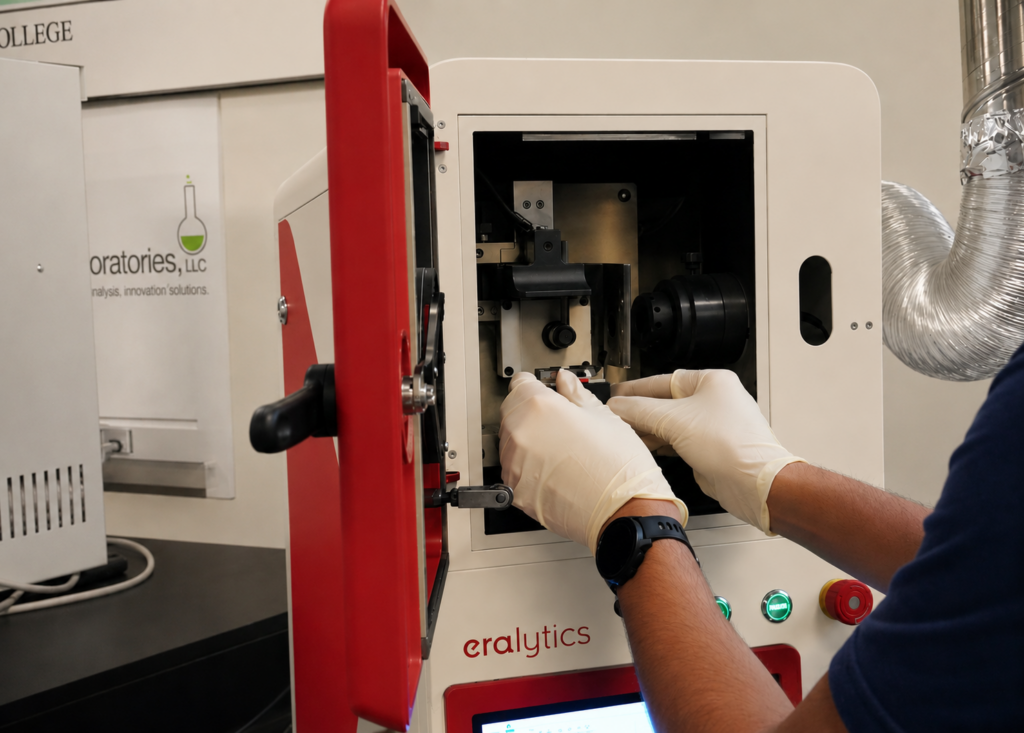
The consistency of grease is determined by measuring the load under varying speeds during the extraction of the grease through an orifice slot.  This is done using a load cell to compress the grease from the Grease Thief onto a thin plastic substrate.  The consistency of the grease is compared to the baseline grease to measure changes in consistency to determine thinning or thickening of the grease.  The GT Index is determined as the percent consistency of the sample as compared to the baseline.

Using the Grease Thief Analyzer, the Grease Thief Loads 1, 2 and 3 measures the consistency of the grease over a series of speed changes (slow → fast → medium).  The speed changes create a step change in force which can be compared to the baseline grease that was exposed to the same speed conditions.  The variable loads are compared and used to calculate the Grease Thief Index.

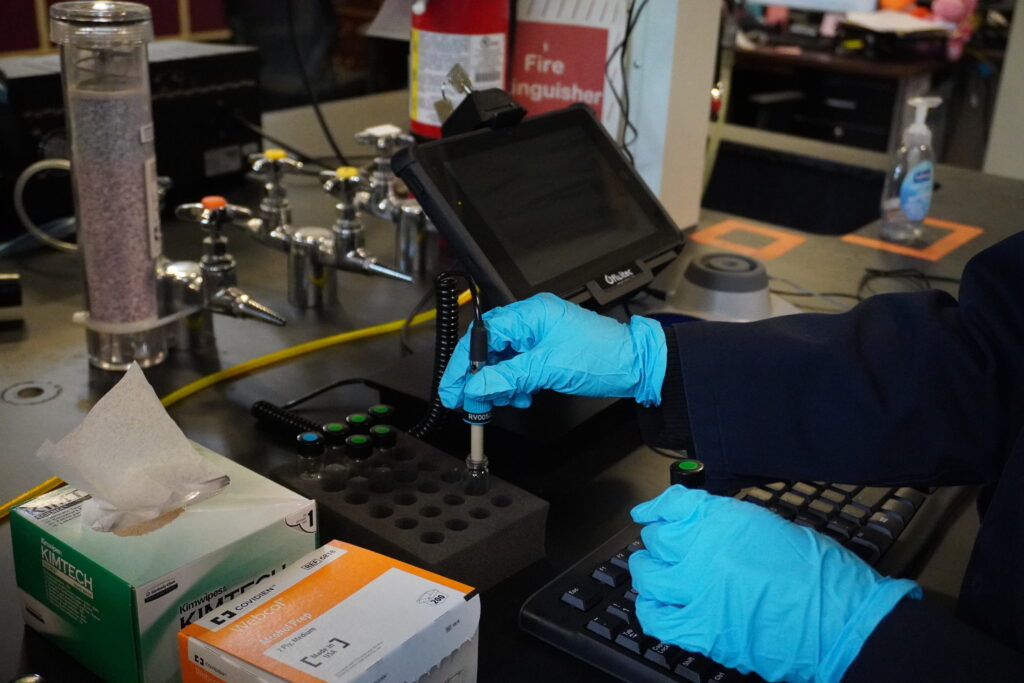
Zinc and Phosphorus Levels are generally indicative of anti-wear or EP additives. The elemental spectroscopy levels are fairly consistent in the sample indicating not much loss of anti-oxidant.  Although, that is not always the case; individual elements can still be present in the sample but not working as a synergistic additive pair. Looking at these elements in combination with the RULER analysis gives a good idea on the amount of anti-oxidant still remaining in the sample.

RULER Technology works on the principle of linear sweep voltometry.  A variable voltage is applied to the sample while the current flow is measured.  The presence of anti-oxidant remaining in the sample is determined.